

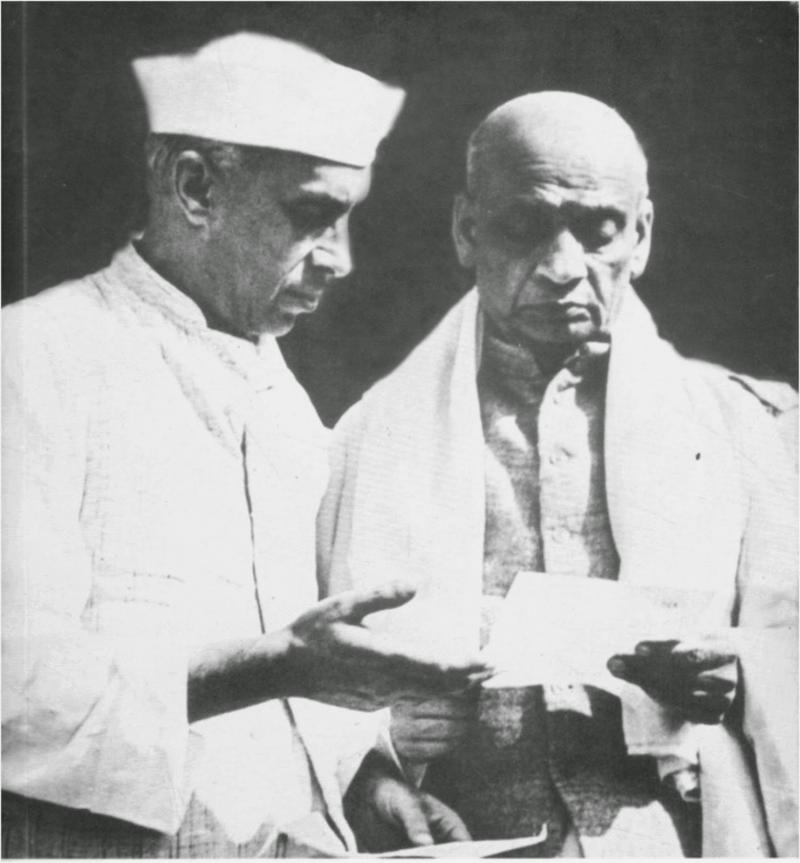
By Sandeep Bhardwaj
One of the pernicious myths of Indian politics that refuses to die is the claim that Jawaharlal Nehru somehow “stole” India’s premiership from Vallabhbhai Patel. The most popular variant of the myth suggests that Mahatma Gandhi manipulated the 1946 internal elections of Congress to install Nehru as its head, even though Patel was more popular within the party and the country. Of course, this claim is patently false. Yet it is propagated time and again by news media, TV shows and even the BBC (which should know better).
Peddling anti-Nehru propaganda is undoubtedly politically profitable these days. But teaching the public that the founding fathers illegitimately captured power by manipulating elections is dangerous for Indian democracy. It also poisons the shared memory of the country’s independence and is, frankly, unpatriotic. Unfortunately, historians have not pushed back against the myth strongly enough. Below I lay out the historical context of Nehru’s ascension and the story of the 1946 elections.
Nehru did not become the Prime Minister because of a single election or because Gandhi installed him. By the mid-1940s, he was the dominant figure in the Congress party, second only to Gandhi himself. He was widely considered as the obvious candidate to lead the party and the country, much more so than alternatives such as Patel, C Rajagopalachari or Rajendra Prasad. Interestingly, none of these top Congress leaders ever personally contested an election before 1947, so we can’t compare their electoral performance to gauge their popularity or political strength. But Nehru’s strong position was evident in his career trajectory, large electoral base, popular appeal, influence within the party, international stature and Gandhi’s endorsement. We can see it in a comparison with Patel’s career.
Nehru was a rising star of Congress from an early age. In the mid-1920s, he became a national figure by assuming leadership of the radical youth wing of the party and demonstrating that he wasn’t afraid to challenge the party’s old guard including Gandhi. He first became Congress President in 1929 at a relatively young age of 40. By comparison, Patel did not become party president until 1931 when he was 56. Nehru served as Congress president four times before independence, while Patel did it only once.
Another important advantage was Nehru’s electoral base in the United Provinces, the heart of the Hindi Heartland. Then, as today, the path to New Delhi went through UP (the second largest province in the country at the time). Nehru was the most popular leader of the province. His hold on the UP Provincial Congress Committee gave him an important platform to influence national politics. In contrast, Patel’s base was Bombay province – a smaller electoral prize. Moreover, it was home to too many political heavyweights. As a Gujarati in a Maharashtrian-dominated province, Patel sometimes struggled to maintain political dominance. For instance, in the late 1930s, he had to put down a mutiny of Congress members from the Bombay city with Nehru’s support.
After Gandhi, Nehru had the greatest cross-country mass appeal. He was the party’s principal vote catcher and election campaigner. He managed the party’s campaigns in the two major elections that Congress contested before independence (1937 and 1945-46). In 1945-46 elections, he campaigned in UP, Punjab, NWFP, Delhi, Bengal, Assam, Sind, Bihar and Bombay. To compare, Patel remained largely confined to his province of Bombay for most of the campaign season. Nehru had more cross-sectional popularity than older establishment figures such as Patel, especially when it came to three critical constituencies – youth, leftists and Muslims. His speeches threaded the needle well between electrifying the public with revolutionary sentiments and winning over the moderates by offering a reasonable tone. He also had an unmatched capacity to articulate a vision for India, which is essential for any national leader.
All this is not to deprecate Patel, who was one of the most prominent figures in Congress. On stage, he was a firebrand equal to Nehru. He had close relationships with India’s capitalist class. He exercised considerable control over the party’s machinery, fundraising and discipline. If party members stepped out of line, they could expect to hear from Iron Man for a dressing down. The zenith of Patel’s power as a party boss reached in the mid-1930s when he blocked the efforts of more radical leaders to move the party to the left.
However, by the 1940s, while Patel’s control over organizational matters continued unabated, the strategic and ideological aspects of party policy came increasingly under Nehru’s influence. In fact, the Pandit’s influence could sometimes even compete with Gandhi’s. For example, Nehru successfully pushed the party to embrace a rapid industrialization program despite Gandhi’s strong opposition. The British Indian government, which watched Congress very closely, concluded in 1942 that Nehru “dominates” the party policy.
Patel’s fourteen years on Nehru also weighed on the older man. For example, in the twelve months after he was released from the prison in 1945, 56-year-old Nehru crisscrossed the country to campaign for the elections, went to Kashmir to agitate, visited Burma and Malaya, led the committee to defend ex-INA soldiers, visited princely states to discuss integration and negotiated with the British and the Muslim League over the fate of Indian independence. 71-year-old Patel, often homebound due to ill health, could not manage such a punishing schedule.
By the early 1940s, Nehru’s eventual ascent to premiership appeared as a foregone conclusion to most. When Chiang Kai-Shek, the Chinese President, visited India in 1942, he was more interested in meeting Gandhi and Nehru than the Chief of Indian Army. British officials were rankled that war-time president of a major Allied power treated Nehru as an equal. But then the British themselves treated Nehru as the eventual leader of the country. Viceroy Linlithgow believed that Nehru was the only popular leader in the entire Congress Working Committee, which otherwise consisted of “declining valetudinarians who have no grip on the country” and “command nothing to matter in votes”.
In addition to all these political advantages, Nehru also had Gandhi’s endorsement. As early as 1942, Gandhi had publicly declared that he wanted Nehru to be his successor. Patel was always Gandhi’s most loyal disciple, yet the Mahatma chose Nehru, who often challenged him. His decision was clearly based on who he considered as the best person to lead the nation. “[Jawaharlal] says he does not understand my language, and that he speaks a language foreign to me,” Gandhi said at the time. “[But] when I am gone he will speak my language.”
Many historians, even the ones sympathetic to Nehru, tend to overstate the impact of Gandhi’s decision. It wasn’t as if Gandhi could handpick whomever he wanted to install as the country’s Prime Minister. There were limits to even his influence over Indian politics. Gandhi’s support certainly helped Nehru’s career, as it always had. But Nehru’s ascension to power was propelled by his own political skill and popularity.

The 1946 Congress Presidential Elections
In the summer of 1946, Congress elected a new party president. Although presidential elections were held annually, they had been suspended for the previous six years due to the Second World War. Maulana Abul Kalam Azad, who had continued to hold the position, was now due to step down. AICC members sent in nominations for five candidates – Nehru, Patel, JB Kriplani, Subhash Chandra Bose and Jayaprakash Narayan. Two last names were removed because Bose was dead and JP was not a formal member of the party. Patel and Kriplani withdrew their candidature, ensuring that Nehru was elected unopposed, assuming the office on 6 July. On 4 August, Viceroy Wavell invited the Congress President to form an Interim Government for the country. Thus, Nehru first assumed power as the head of the Interim Government and continued to serve for the next eighteen years uninterrupted.
Proponents of the “stolen premiership” myth have zeroed in on the 1946 election as the moment of manipulation. As far as I can tell, the controversy originated from two sources. One was JB Kriplani’s book on Gandhi. Kriplani, Congress General Secretary in 1946, claims that in the runup to the presidential elections, party officers nominated Patel and Kriplani but no one nominated Nehru. Since Kriplani knew that Gandhi wanted Nehru to be the party president, the general secretary orchestrated Nehru’s nomination behind the scenes. He then withdrew his own name and pressured Patel to do the same. “It was certain if Jawaharlal’s name had not been proposed, the Sardar would have been elected as the President,” Kriplani writes. “The Sardar did not like my intervention.”
The second source of controversy was Michael Brecher’s biography of Nehru (1959) in which he asserts that 12 of 15 Provincial Congress Committees supported Patel while others backed Nehru. Gandhi persuaded Patel to step aside for Nehru. Brecher goes on to speculate that Nehru’s election as party president directly led him to head the Interim Government. “If Gandhi had not intervened, Patel would have been the first de facto Premier of India,” Brecher writes. “The Sardar was ‘robbed of the prize’ and ‘it rankled deeply’.” Thus, the “stolen premiership” myth was born.
First, the veracity of the sources is somewhat doubtful. Brecher’s account is based on his conversation with only one unnamed person more than a decade after the fact. Kriplani wrote in 1970, long after he had a bitter falling out with Nehru and turned into a bitter critic of the Congress government.
Second, it is highly unlikely that Nehru was not nominated or lacked support. While announcing that he would be stepping down as president, Azad publicly endorsed Nehru. The press declared Nehru as the prohibitive favourite before the nomination process was even complete (Times of India, 27 April 1946). The annual Congress Presidential elections were not open contests. They were stage-managed events which usually produced unanimous results pre-determined by the Congress High Command. Outgoing presidents often nominated who they thought should be their successors and encouraged AICC members to vote accordingly, as Patel himself had done as the outgoing president in 1932 for Rajendra Prasad. It was completely normal for some candidates to withdraw to allow for a unanimous choice in the consensus-driven Congress party politics.
Finally, and most importantly, the party presidency had no bearing on who would become the Prime Minister. Congress Presidents were rarely the most powerful figures in the party. Even today, party presidents are not automatically considered the leaders of their parties (BJP President JP Nadda and Congress President Mallikarjun Kharge are not considered the foremost figures of their respective parties). Nehru was expected to become the Prime Minister regardless of whether he was the Congress President or not. Even before assuming the presidency, he was the party’s point person negotiating with the British and the Muslim League. Discussions of the period show that Viceroy Wavell was clearly operating on the assumption that Nehru would head the Interim Government. (Point of note for those who allege that Viceroy Mountbatten installed Nehru to power: Nehru first became head of the Interim Government under Wavell, nearly six months before Mountbatten took over.)
Furthermore, the presidency did not give Nehru power to form the Interim Government as per his whims. Congress appointed a sub-committee consisting of Nehru, Patel, Azad and Prasad to draw up the list of Interim Government members. Nehru became the head of the government only after long discussions with and explicit support of other major stalwarts of the party.
In July 1946, Nehru’s ascent to premiership was a foregone conclusion. Even those supporting Patel for party presidency understood it. Patel’s own biographer Rajmohan Gandhi quotes DP Mishra, a staunch supporter of Vallabhbhai: “When we… preferred [Patel] to Nehru as Congress President, we had no intention of depriving Nehru of future Premiership… As regards to the Premiership of India, we always had a vague idea that… Nehru was bound to occupy that exalted office at the dawn of freedom.”
In fact, Patel himself expressed this sentiment: “Presidents come and go. He [Nehru] might be President or not be President. But it will be he who will have to bear the burden of the country.” (Hindustan Times, 22 November 1946).
We should also consider the fact that there is no evidence to suggest that Patel ever expressed a desire to lead the country or staked a claim for premiership. Too often historians and fictionalized recreations depict Patel as a man secretly harbouring the desire to become Prime Minister and then silently sulking when he is denied. All such ambitions ascribed to him are post-facto speculations. It is a disservice to portray him as a supine politician stifling his desires under pressure from others, instead to see him as he really was – a political giant who threw his support behind a leader he believed was best suited for the job and the time.
In the end, perhaps the strongest evidence to prove that Nehru became the Prime Minister because of his popularity and political skill is the fact that once he gained power, Nehru never lost it until his death. Even after he had led the country into a disastrous war with China and collapse of the Economic Planning process, no one even challenged his position as the Prime Minister, let alone try to unseat him. Until 1964, he remained the foremost politician of the country.
Sources: Sarvepalli Gopal, Nehru: A Biogray; Michael Brecher, Nehru: A Political Biography; Rajmohan Gandhi, Patel: A Life; JB Kriplani, Gandhi: His Life and Thought; Transfer of Power Volumes; Annual Register; Times of India; Hindustan Times.
 Revisiting India
Thanks for debunking the Godi media lies, even the Palki Sharma whom Iuse to admire she too fall in the propaganda of this fake news
Much of this information is fabricated and leaving out important facts. Twisted to please Nehru sycophants and hide facts of the alternate history very much noted and available
yes👍
yes you are right. It is a news false and fabricated. Person like me whor born well before independace knows the real story
yes fake information
When Michael Brecher’s book, Nehru: A Political Biography; came in 1959, Nehru was very much alive at that time; He (Nehru) did not utter a single word against the facts cited in the book. No counter claims in press, no mass demonstrations, no book burnings by the then congress supporters. What does it mean;
Yes you are 100% correct as far as Nehru’s mass acceptance is concerned. When I was a school going boy in the 1960s earlier two generations – parents and grandparents – always used to speak about Gandhi and Nehru only. Whether right or wrong only Gandhi and Nehru were frequently mentioned when discussions centre around freedom struggle. Especially in my native village hardly anybody knew about Sardarji but they all knew very well Gandhiji and Nehru.
Another thing Gandhi bashers should note that Sardarji died on 15-12-1950 after which there was no choice but only Nehru. Nehru died in 1964 so our country had no other choice but only Nehru.
In continuation of my earlier comments some more points should also be added. Personally I didn’t like India Gandhi’s politics. But why did Kamaraj select Indira for Prime minister post after Shastriji’s death? Instead of selecting Shri Morarji Desai he opted for Indira. Kamaraj was worried about impending election. In 1967 election was due. Kamaraj factored in 20 years of Anti incumbency faced by both the central and state governments. That’s why he felt Nehru clan will get votes for Congress. When I grew older I felt Morarji Desai should have become Prime minister instead of Indira especially after coming to know about Indira’s way of politics. But at the same time it was doubtful Desai could have garnered votes for Congress.
To be continued.
yed
To the attention of Gandhiji and Nehru bashers Michael Brecher’s book, Nehru: A Political Biography also says
“Brecher also made comparisons between Nehru and other leaders. But some of them, obviously, would have come not from his direct interactions, but from other sources. For instance, Sardar Patel, who died in 1950, figured prominently in his comparison with Nehru. Brecher says: “Nehru is a man of great charm, generous to a fault, sensitive and aesthetically inclined, impulsive and emotional. Patel was generally dour and ruthless, unimaginative and practical, blunt in speech and action, cool and calculating. Nehru disliked political intrigue; he was a lonely and solitary leader, above group loyalties. Patel was a master of machine politics. Nehru was the voice of the Congress, Patel its organiser (and Gandhi its inspiration),” (Ibid 152).”
YES, I admire your research and putting facts along with quoting news paper dates and this kind of research is appreciable. Knowledge and facts update for this new generation who easily influence by social media and by other influencer’s talk shows who was not born and not even know about independence struggle and sacrifices given by our fore fathers at that time. But simply passes the statements whatever they think is right and pointing out our own great freedom fight leaders who fought for us and sacrificed every thing for dreaming about our country Independence.
What a failed attempt to white wash Nehru, the ditactor 😄
We are not fools.. Copy of then news papers available in archives