
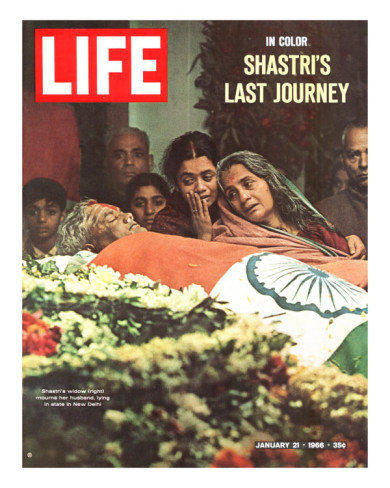
Shastri’s body brought home
On the grey winter afternoon of 11 January 1966, a huge crowd of Indian Government officials, politicians, military officers, heads of states of other nations and common public thronged the Palam Airport in New Delhi. They were awaiting a small Soviet aircraft bringing in the dead body of India’s second Prime Minister, Lal Bahadur Shastri. India had woken up to Shastri’s sudden death in Tashkent, Uzbekistan only hours ago. A sense of uncertainty over India’s political future surrounded the airport thicker than the Delhi fog. Many had come to the airport to mourn Shastri’s death, many for appearance sake. But at least one person was there for a clearer purpose. Clad in white khadi, was an astrologer, much consulted by top-level Congress politicians. He was there to predict who will be the next Prime Minister.
Unlike with Nehru, no one had anticipated Shastri’s death and there had been no discussion over the issue of his succession. Only two hours after his death, the President had sworn in the home minister, Gulzari Lal Nanda as the acting Prime Minister in the middle of night. But Nanda was considered a light-weight, unlikely to be able to turn his job permanent. Nevertheless, within twenty-four hours he threw his hat in the ring to be considered as the next Prime Minister. So did many others. Within two days of Shastri’s death, the list of politicians circling around the throne had grown considerably, including the defence minister YB Chavan, Mahashtrian politician SK Patil and the future President of India Sanjiva Reddy. But the strongest candidate was Morarji Desai.
Desai had already had already had bitter experience in his ambition to be India’s Prime Minister. In early 1960s, Desai was a centre of power within the Congress Party. A right-leaning, pro-business conservative leader, he had emerged as the opposing pole within the party to left-leaning, liberal Nehru. As the finance minister in Nehru’s Government, he had become so influential as to be considered by many as his natural successor, to the extent that in some of his foreign visits he got the treatment reserved for visiting heads of state. Had Nehru not eased him out of the Cabinet in 1963, he would have most likely become the next Prime Minister automatically. Instead, in 1964, when Nehru passed away, it was the unimpressive Shastri who got the chair, a shy, placating man who was so unimposing that his greatest achievement at the time seemed to be that he had “hardly ever made an enemy during his entire career”.
Continue reading →





 Revisiting India